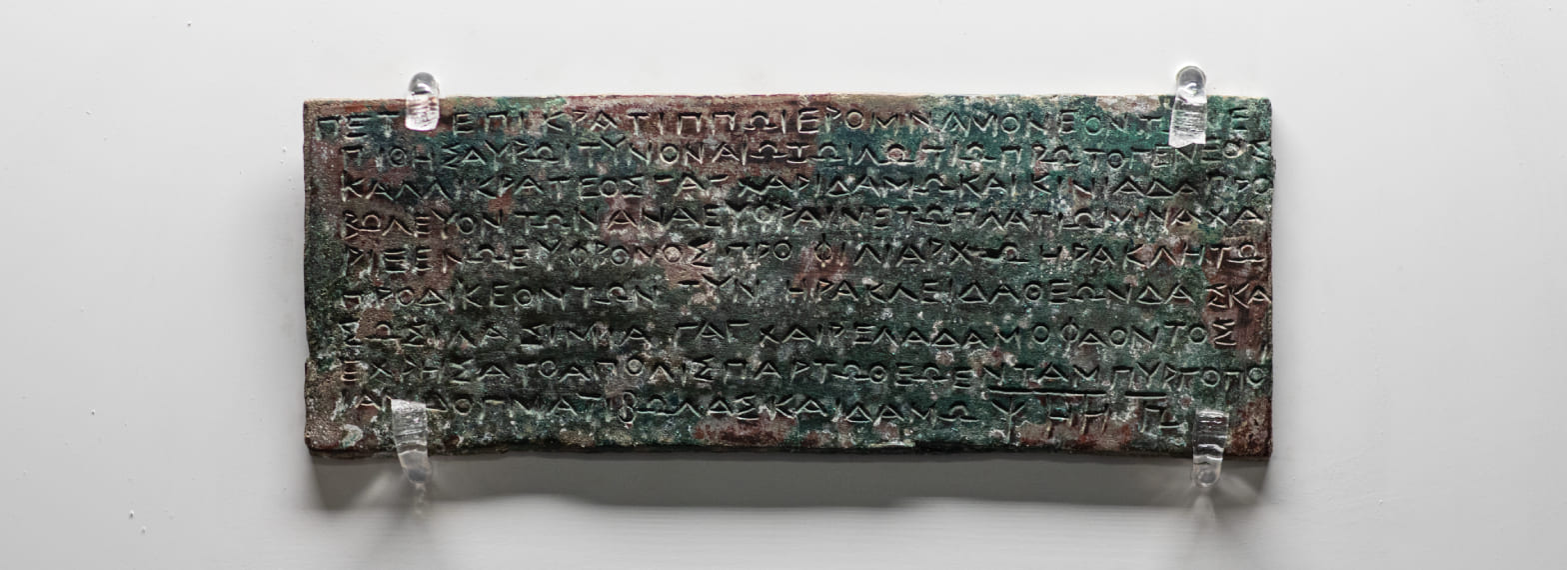
Calabria was the beating and vital heart of Magna Graecia. Starting from the 8th century B.C., peoples from mainland Greece colonized the eastern coasts of Calabria, founding the earliest poleis of Crotone and Sybaris. These then expanded into a network of cities that formed the colonies of Magna Graecia: Hipponion, Kaulonia, Krimisa, Kroton, Locri Epizephyrii, Medma, Methauros, Rhegion, Skylletion, Sybaris, Temesa, and Terina.
Numerous testimonies of this illustrious history still remain. The idea of creating a National Museum with materials unearthed from excavation campaigns at major Calabrian sites took concrete form thanks to the efforts of archaeologist Paolo Orsi, who worked to merge the civic and state collections. In 1954, superintendent Alfonso De Franciscis partially opened the Museum to the public. It was officially inaugurated in 1959.
Until its expansion in 1981 and 1982, the collections included a Prehistoric and Protohistoric Section (opened in 1962), a rich core of artifacts from Locri, an important numismatic section, a Lapidary, and a Picture Gallery inaugurated in 1969 with the collaboration of superintendent Raffaello Causa and architect Aldo Grillo. Exhibits included selected materials from the Tyrrhenian and Ionian colonies of Magna Graecia, from Hipponion-Vibo Valentia, Rosarno-Medma, and Reggio. In the Hall of the Apollo of Cirò, finds from various Calabrian locations were displayed.
The underwater archaeology section, created in 1981, was dedicated to housing the two famous bronze statues discovered in 1972 on the Riace seafront, along with the equally renowned “Head of the Philosopher” and the so-called “Head of Basel” (named after the Swiss city where it was stolen and held illegally for nearly thirty years). The latter was recovered from the Strait of Messina near Porticello, close to Villa San Giovanni, in 1969.
An additional exhibition section was added in 1982, inaugurated on the occasion of the Centennial of the Civic Museum and the Fiftieth Anniversary of the State Museum. This completed the overview of archaeological evidence related to the Greek colonies and their sub-colonies on the Tyrrhenian and Ionian coasts of what is now the Calabrian region.
The collections of the old Civic Museum consist of selected materials from the Reggio area and also cover ethnology, medieval and modern art, and mementos from the Italian unification movement (Risorgimento). Of notable interest and importance is the numismatic collection, transferred from the Civic Museum to the Coin Cabinet, as well as the Picture Gallery, which includes, among other works, two panels by Antonello da Messina.