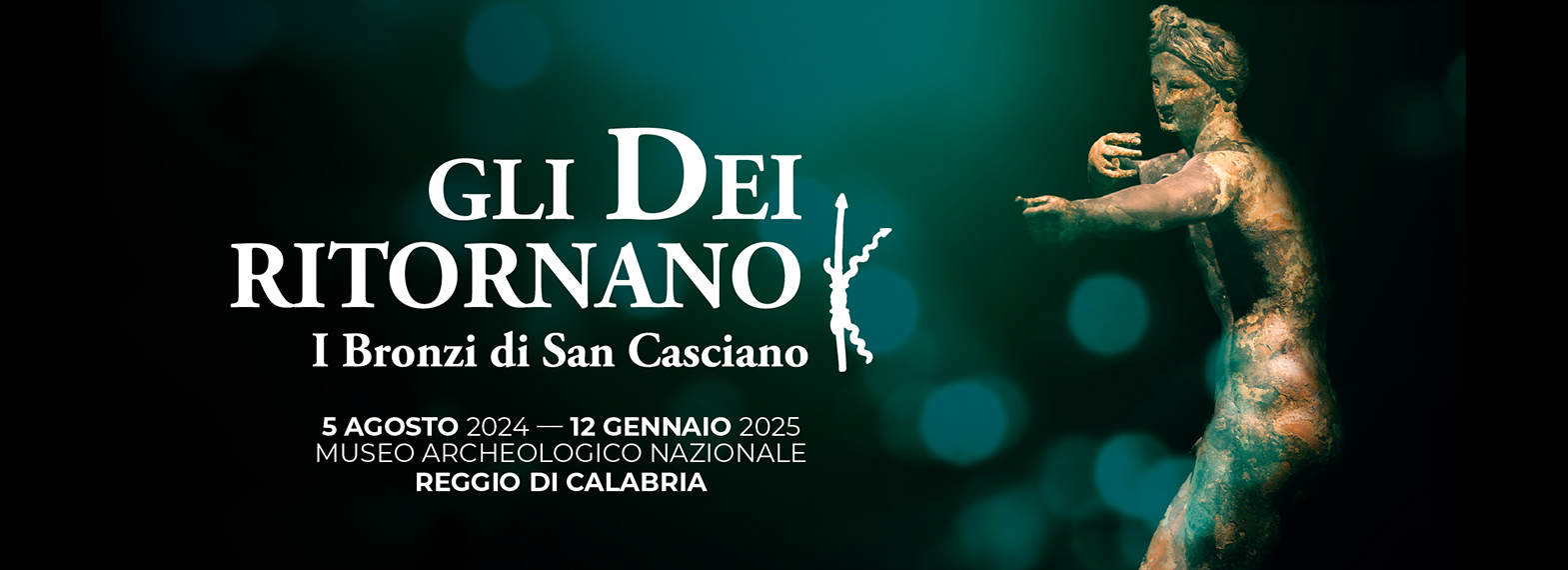
The great discoveries of the Etruscan and Roman sanctuary on display at the National Archaeological Museum in Reggio Calabria from 5 August 2024 to 12 January 2025
A journey through the centuries to discover the landscape of warm waters between Etruscans and Romans in the territory of the ancient Etruscan city-state of Chiusi
The exhibition “Gli Dei ritornano. I bronzi di San Casciano” was inaugurated on 5 August 2024 at the National Archaeological Museum of Reggio Calabria (MArRC), curated by Massimo Osanna and Jacopo Tabolli, dedicated to the famous finds made in the Etruscan and Roman thermal sanctuary of Bagno Grande in San Casciano dei Bagni.
Now in its third stage, after the public success at the Palazzo del Quirinale and the National Archaeological Museum of Naples, the exhibition offers a new opportunity to immerse yourself in the fascinating universe of ancient Etruscan and Roman rituals related to thermal waters.
At the inauguration, after the institutional greetings of the Mayor of the Municipality of Reggio Calabria Giuseppe Falcomatà and the Mayor of the Municipality of San Casciano dei Bagni Agnese Carletti, the Director of the National Archaeological Museum of Reggio Calabria Fabrizio Sudano and the Scientific Coordinator of the excavation and Associate Professor of Pre-Roman Italy Civilization and Etruscology at the University for Foreigners in Siena Jacopo Tabolli. The presentation was concluded by the General Director of Museums, Massimo Osanna.
“The exhibition dedicated to the Bronzes of San Casciano, now housed in the National Archaeological Museum of Reggio Calabria, offers visitors the opportunity to admire artifacts and works of great interest, but also to appreciate the results of an ongoing archaeological research. The bronze statues were in fact found and excavated in their original context and this allows to study and reconstruct the stories of people who frequented the ancient sanctuary, which from the third century B.C. to the fifth century A.D. made thermal water its fulcrum. The story of this center of ritual and worship, which was first Etruscan and then Roman, runs through the exhibition path as a journey in the landscape of sacred waters, but is at the same time a trip to the stages of the most authentic archaeological research. Thanks to the collaboration between the Italian Museums, the Soprintendenza, the University and the local authorities a process of valorization of the results of studies has been set up which should be the ultimate goal of all museum projects“, commented Prof. Massimo Osanna.
“It is with pride that the project started from the small community of the Municipality of San Casciano dei Bagni, after being welcomed to the Palazzo del Quirinale and the National Archaeological Museum of Naples, arrives in Reggio Calabria to give shape to that parallelism that instinctively each of us has made when he heard about “bronzes”, said the Mayor Agnese Carletti. “In fact, these are two completely different worlds and contexts that will however be able to value each other in this journey that the bronzes of San Casciano are doing and that ties to the museum that anxiously awaits the community to give new life to the link between these masterpieces of Etruscan age and Roman in their birthplace”.
“I am honoured to host the exhibition of the Bronzes of San Casciano at the National Archaeological Museum in Reggio Calabria. From the first days of my directorship at MArRC, in January 2024, I strongly wanted the two most important archaeological discoveries of the last two centuries – that of the Bronzes of San Casciano and the Bronzes of Riace – to be found right at the museum of Reggio Calabria, with the intention of proposing the same Museum as the symbol place of Italian archaeology in the world”, said the director Fabrizio Sudano. “Fifty years apart, the two discoveries are always at the center of attention and will still make you talk about yourself in the future”.
“The occasion of the exhibition is also linked to the continuation of the excavation at Bagno Grande – commented prof. Jacopo Tabolli – Over the past weeks more than sixty students from universities around the world have worked in the Etruscan and Roman sanctuary, shedding new light on the oldest phase and at the same time bringing to light new and exceptional data on the rites and cults that took place around and inside the thermal spring. The importance of ancient medicine prayed and practiced in the place of worship becomes increasingly clear. An extraordinary training opportunity for young archaeologists who see in this exhibition the completion of their labours”.
From the extraordinary opening on the afternoon of 5 August, from 16 to 20, and until 12 January 2025, to the public of the National Archaeological Museum of Reggio Calabria, home of the Bronzes of Riace, are presented the extraordinary discoveries made in the summer of 2022 and the novelties that came to light in 2023 in the thermal sanctuary of Bagno Grande di San Casciano dei Bagni. A stratigraphic excavation that has brought to light the largest deposit of bronze statues of Etruscan and Roman age ever discovered in ancient Italy and one of the most significant throughout the Mediterranean. Reproductions of anatomical parts, offered to ask the gods for health or thank them for a healing, and statues made according to the canons of the so-called mensura honorata (three Roman feet high, equivalent to about one meter), which depict the deities venerated in the sacred place or the devotees. Most of these valuable finds date from the second and first centuries BC, a period of great historical transformations that sees the definitive romanization of the powerful Etruscan cities.
The exhibition was promoted by the Ministry of Culture and implemented by the Directorate-General Museums of the MiC with the National Archaeological Museum of Reggio Calabria, thanks to the collaboration between a plurality of institutions responsible for research, protection and enhancement of heritage. The archaeological excavations are in concession to the Municipality of San Casciano dei Bagni by the Directorate-General for Archaeology, Fine Arts and Landscape of the MiC, with the protection of the Superintendence for Archaeology, Fine Arts and Landscape for the Provinces of Siena, Grosseto and Arezzo and the scientific coordination of the University for Foreigners in Siena. The restorations have been carried out with the support of the Istituto Centrale del Restauro. The exhibition was designed by Guglielmo Malizia and Chiara Bonanni, Decima Casa – architectural studio.
The press kit with images will be updated on the website musei.beniculturali.it
The museum is open from Tuesday to Sunday (closed on Mondays), with continuous hours from 9:00 to 20:00, last entrance at 19:30. Admission is always free up to the age of 18. All the info on museoarcheologicoreggiocalabria.cultura.gov.it The visits take place during the usual opening hours that can be consulted online, with the possibility of booking for individuals and groups. Bookings, additional services and ticketing are handled by Coopculture. To book the visit: 0639967600 (active Mon-Sun 9-18), for info and reservations sector Didactics/Schools: 0639967600 and edu@coopculture.it; for reservations Groups: 06 39967600 and tour@coopculture.it