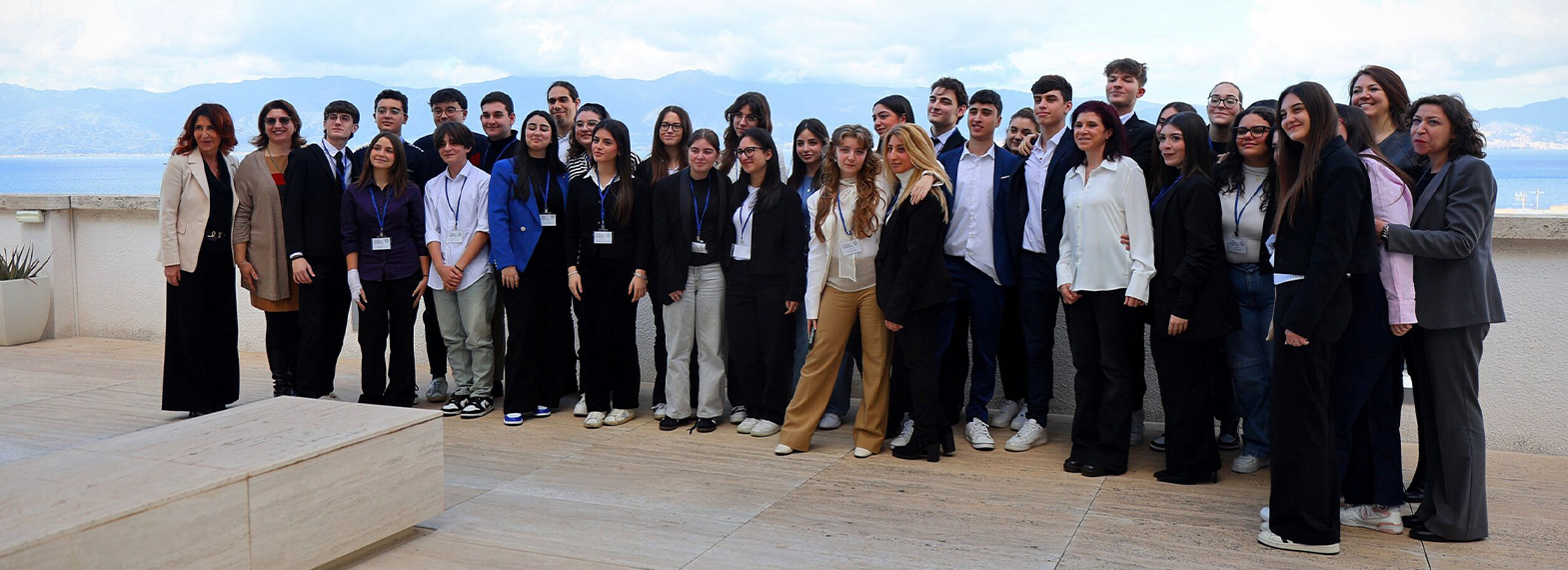
The project, which started in April last year and resumed after the summer break, included training modules with face-to-face lectures, guided tour within level D, research activities and operational modules, where the students actively carried out their assigned tasks, production of multimedia and paper material.
It was a complete PCTO of knowledge and concrete implementation of actions, in which the children have acquired important transversal skills useful for their future.
Followed in these months by the Tutor of the host facility, Official Arch. Dr. M. Assunta Ambrogio and the teachers Tutor prof. sse C.M. De Fontis and C. Piloro, the children were directed not to be temporary users, passing users, passive visitors of the museum and the experience of PCTO, but they were guided to be true “visit-actors”.
Actors of their path, involved in carrying out and simulating work activities, in the museum context and specifically in the activities related to the office of educational and teaching services.
They developed a PCTO designed for them, marked by a participatory path, with co-design activities made not only between the museum and the school, but that allowed them to cooperate, working as a group, designing together and choosing the way to enhance the level D of the museum that displays the findings related to the foundation of Reggio Calabria; knowing also the needs of the wide public that uses the museum and deciding to develop some of the activities that improve more and more the use and knowledge of our city.
Aware that it is not enough to sensitize these children on heritage issues, but they must be actively involved in the design of cultural services (e.g. creation of cultural products aimed at their peers, educational activities to involve especially the little ones), the Museum and the school have worked in synergy for the success of the project.
Simulations were developed with didactic methodology that uses in a natural way problem solving, learning by doing, cooperative learning and role playing, to work on the project and the final objectives.
The project allowed to create a positive relationship/experience between the children and the Museum, to develop a sense of affection and knowledge of the heritage. The young people “putting themselves in play” and developing the acquired skills integrated with transversal skills, have created cultural products that, enhancing their work within the host structure and increasing their knowledge, have allowed and will allow the educational office to draw on the material produced as a support for future activities.
In the presence of many parents, after the greetings of the director dott. F. Sudano and the head of the school, Dr. F. Arena and the interventions of the referent PCTO Prof. C. Novello and Dr. M.A Ambrogio, the children of the two classes presented their work to the public.
Specifically, class 4 A showed a multimedia product, which illustrates the history of the foundation of the city, linked to the Greek myth narrated by Diodorus Siculus, aimed at an age group 16+; games to be used as “room sheets” for curiosity and attention to the findings of the windows or that can be used in laboratory activities and an illustrative cartoon, for a 6-12 age group, which tells of the foundation of Rhegion.
The class 4 E that during the first guided visit at level D, decided to attend the findings found at the archaeological site Griso-Laboccetta, dedicated to the deities Demeter and Persephone. Starting from the story of the myth of the abduction of Persephone, they have created educational activities such as a cartoon in Italian and English, an interactive quiz game and a lesson sheet for people between 6 and 12 years old.
At the end of the presentation, Arch. C. Ventura responsible for the promotion office, of which the educational services are an integral part, expressed his satisfaction with the work carried out by all those involved, complimenting especially the children on the products made.